
Two Weeks in Vietnam: on a Small Group Tour
Hanoi to Ho Chi Minh
If Vietnam is on your wish list but you are not sure where to start, a small group tour is a brilliant way to see the country. Over two weeks you can travel from Hanoi to Ho Chi Minh City, taking in Halong Bay, Hue, Hoi An and Da Nang, with expert local guides and the logistics all taken care of. This blog is based on my own experience on a G Adventures–style Vietnam small group tour, using my travel diary to give you a realistic picture of what to expect.
Vietnam is long, busy and gloriously full on. In two weeks you might take an overnight train, go from cool misty bays to hot lantern-lit streets, and bounce between cities, countryside and beaches. Doing that independently is absolutely possible, but for many people it is a lot to juggle.
On a small group tour:
- Airport transfers, hotels and most transport are included, so you are not battling with taxis or timetables after a long flight.
- Local guides share stories, history and food recommendations you simply would not get alone.
- You have ready-made company while still enjoying free time to explore.
- You can try things that might feel daunting solo, like sleeper trains, motorbike days or cycling through the countryside.
For nervous first-timers to Asia, solo travellers or anyone short on planning time, it is an excellent way to see Vietnam.
Days 1–2: Arrival in Hanoi and getting your bearings
My trip started with a flight from London to Hanoi with a stop en route. Using airport lounges made a huge difference: somewhere to shower, snack and decompress before landing into the chaos of Vietnam.
Smooth arrival
We had booked an extra pre-tour night in the same hotel used by the group, and I had arranged the arrival transfer through G Adventures. After a long travel day, being met at the airport and whisked straight to the hotel meant we did not have to think about anything. We reached our room around midnight and fell into bed.
First day in Hanoi
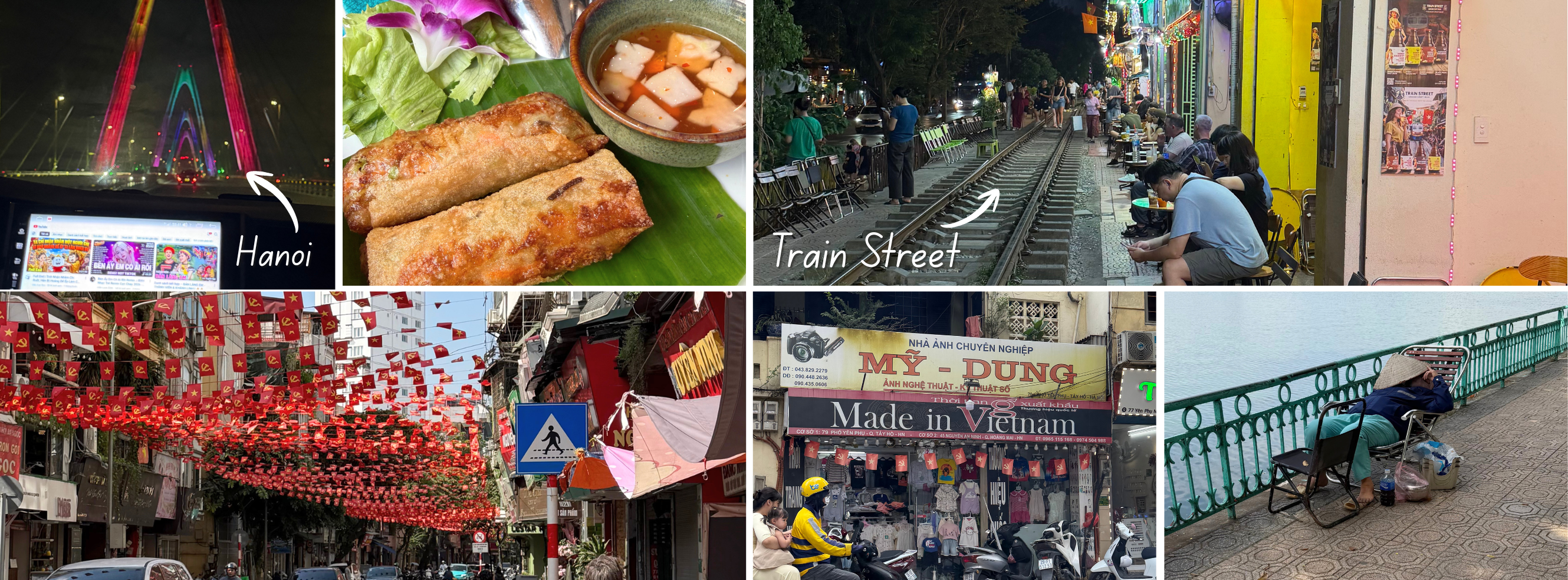
With a full free day before the welcome meeting, we started to explore:
- Dong Xuan Market: a cavernous local market selling absolutely everything. It is noisy, busy and a perfect first immersion into Hanoi life.
- Tea by the lake: stopping for a drink overlooking the water is a gentle way to watch daily life swirl by in the Old Quarter.
- Seafood lunch: Vietnam is heaven for food lovers, and Hanoi’s seafood is a great introduction.
- Train Street:
After supper we headed to the famous Train Street, where the railway runs inches from tiny cafés and homes. On our visit the tracks were flanked by neat little tables and stools. We found a café, ordered gin and tonics and waited for the train. When it comes through it is loud, dramatic and incredibly close, with staff shepherding everyone safely inside.
Hanoi was spotlessly clean, friendly and nothing like the chaos I had imagined. That first evening we met the rest of our group at the welcome meeting and started to get to know each other.
Days 3–4: Halong Bay cruise and Titop Island
From Hanoi we drove east to Halong Bay, one of Vietnam’s most famous landscapes and a UNESCO World Heritage Site.
En route: handicraft stop
On the way we stopped at an organisation supporting an embroidery and handicrafts workshop where young disabled artisans produce beautiful pieces. It was fascinating to see the skill involved and a good chance to buy something meaningful rather than generic souvenirs.
Overnight junk boat on Halong Bay
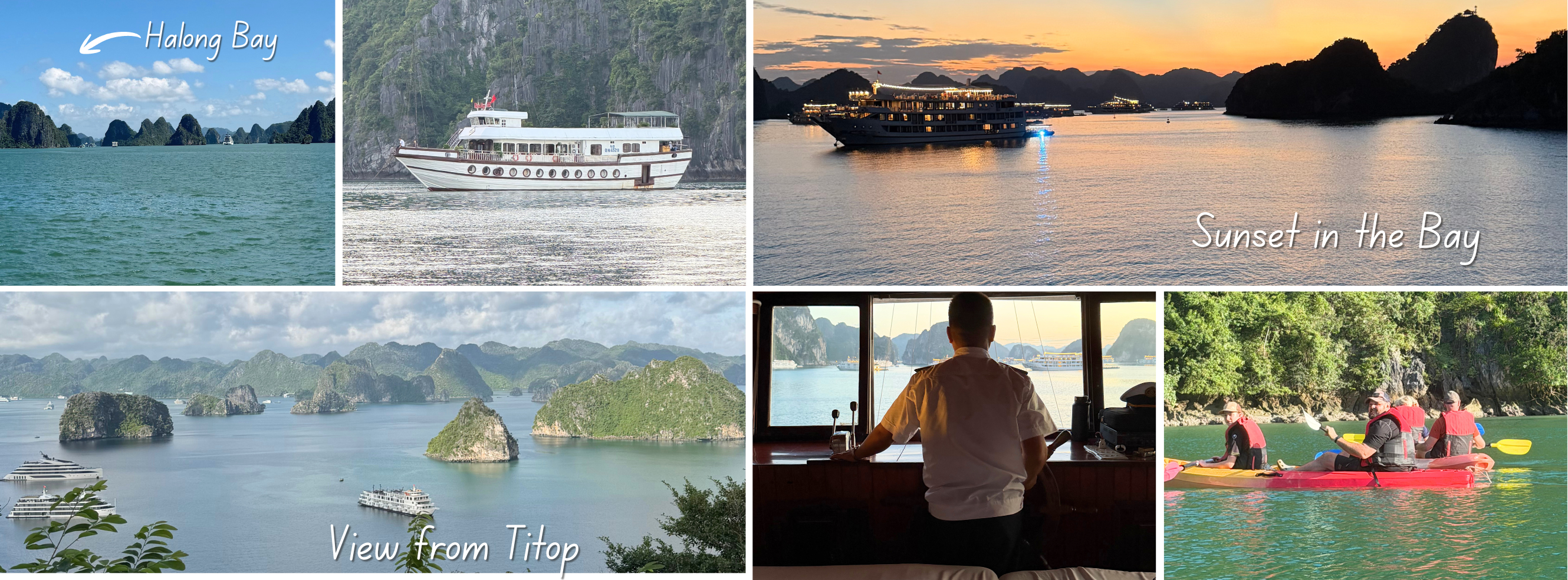
I had heard mixed things about Halong Bay: tales of crowds and over-tourism. Our experience was very different. We had:
- Beautiful weather and calm, emerald water.
- A junk boat to ourselves as a group, which made it feel special and intimate.
- An amazing lunch on board as we cruised among the limestone karsts.
- Time to explore caves, clambering through cool, dark chambers and slippery rocks.
- Kayaking under towering cliffs and a swim off a hidden beach.
- Cocktails on deck at sunset, followed by karaoke that everyone ended up joining in with.
That night the bay felt quiet and peaceful, and the sense of being somewhere completely different really sank in.
A word on drinks: they are not cheap on board. We only discovered at the end that we had been served doubles all evening, which pushed the bill up. It is worth checking measures and prices before you settle in for a big night.
Titop Island: 400+ steps for that view
Early next morning we climbed over 400 steps to the top of Titop Island. It is a steep, sweaty ascent in the heat, but the panoramic view of Halong Bay makes every step worthwhile: islands scattered across the water like emeralds.
We descended in time to be back on the boat for a final cruise back to shore, cameras full and legs just a little wobbly.
Day 5: Back to Hanoi and the overnight train to Hue
Returning to Hanoi, we had an afternoon free before our next adventure: the sleeper train to Hue.
A few of us joined a foodie tour, which was an excellent way to squeeze in more street food and local favourites before heading south.
Overnight train experience
In the evening we headed to Hanoi railway station and boarded the sleeper:
- Compartments had four bunks, each with a pillow and blanket.
- Simple snacks like bananas, fruit and cans of Coke were waiting on the table.
- The western-style toilets at the end of the carriage were perfectly usable and far better than some I have experienced elsewhere.
Just after we pulled out of the station, the train rolled through Train Street again. Seeing it from inside the carriage, instead of perched in a café, was magical.
Did we sleep? Not much. The bunks were rock hard and the train rocked and rattled through the night. Would I do it again? Absolutely. It is an experience in its own right and a very atmospheric way to travel Vietnam.
Days 6–7: Hue, the Imperial City and a Hue Motorbike Adventure
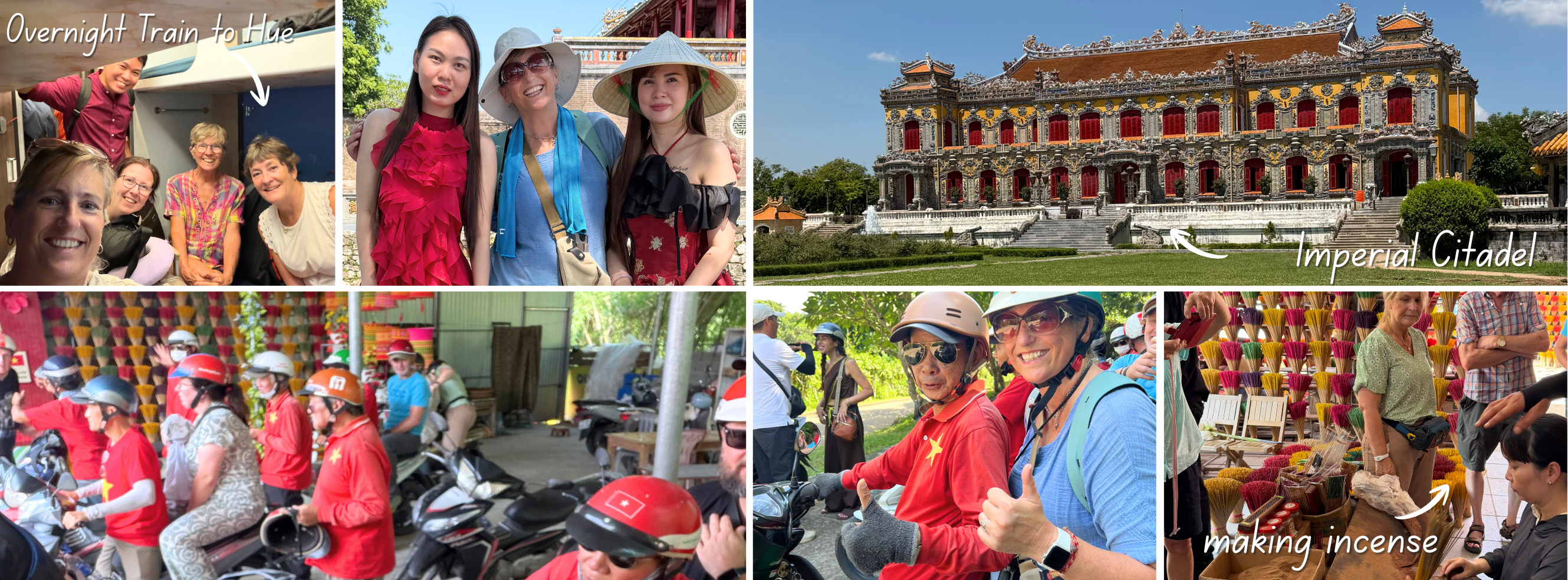
We rolled into Hue around 8.30 am, dropped our bags at the hotel and headed straight out.
Imperial Citadel
We spent part of the morning at the Imperial Citadel, the former home of the Nguyen emperors and another UNESCO site. It is a huge walled complex surrounded by a moat, with palaces, courtyards and temples. Walking through, you feel the weight of history and get a deeper sense of how modern Vietnam was shaped.
Hue by motorbike: a standout day
The next part was one of my favourite experiences of the entire tour: a full-day motorbike tour around Hue and the surrounding countryside, arranged with expert local riders.
How it works:
- Outside Thien Mu Pagoda, our bikes and riders were waiting. There was no careful allocation, just a helmet filled with keys. Whatever key you drew, that was your bike and rider.
- You sit on the back; they do all the riding. Helmets are fitted, and they help you on and off at every stop.
Our riders were fantastic: safe, calm, and endlessly helpful. They pointed things out as we rode and made sure we were comfortable throughout.
Key stops included:
- Thuy Xuan arena, where elephants and tigers once fought before the royal court. Now it is quiet and overgrown, but you can imagine the drama.
- An incense-making village, with bright bundles of incense sticks laid out to dry like colourful flowers.
- The Tomb of Emperor Minh Mang, a serene complex of courtyards, lakes and pavilions laid out in perfect symmetry.
- A viewpoint over the Perfume River, ideal for photos and a breather.
- Sac Tu Quoc Monastery, where we arrived during a procession of chanting monks and women carrying flowers. It was beautiful and humbling, a reminder these are living religious sites, not just sights on a list.
- Thanh Toan museum, where we learnt about rice farming and traditional tools that have sustained local life for generations.
Between stops we rode back roads and tiny villages, past rice paddies and everyday life. The breeze on your face in the heat is bliss, and you see a side of Vietnam you simply cannot access from a coach window.
If you are nervous about riding on a motorbike, I would still encourage you to go. With good riders you quickly relax, and it may well become the highlight of your Vietnam tour. Would I send my own family on it? In a heartbeat.
Days 8–10: Hoi An, countryside cycling and lantern magic
From Hue we travelled by road to Hoi An, stopping at an oyster farm en route to learn about cultured pearls. Watching how a tiny piece of shell determines the colour of the pearl was unexpectedly fascinating.
Arrival in Hoi An
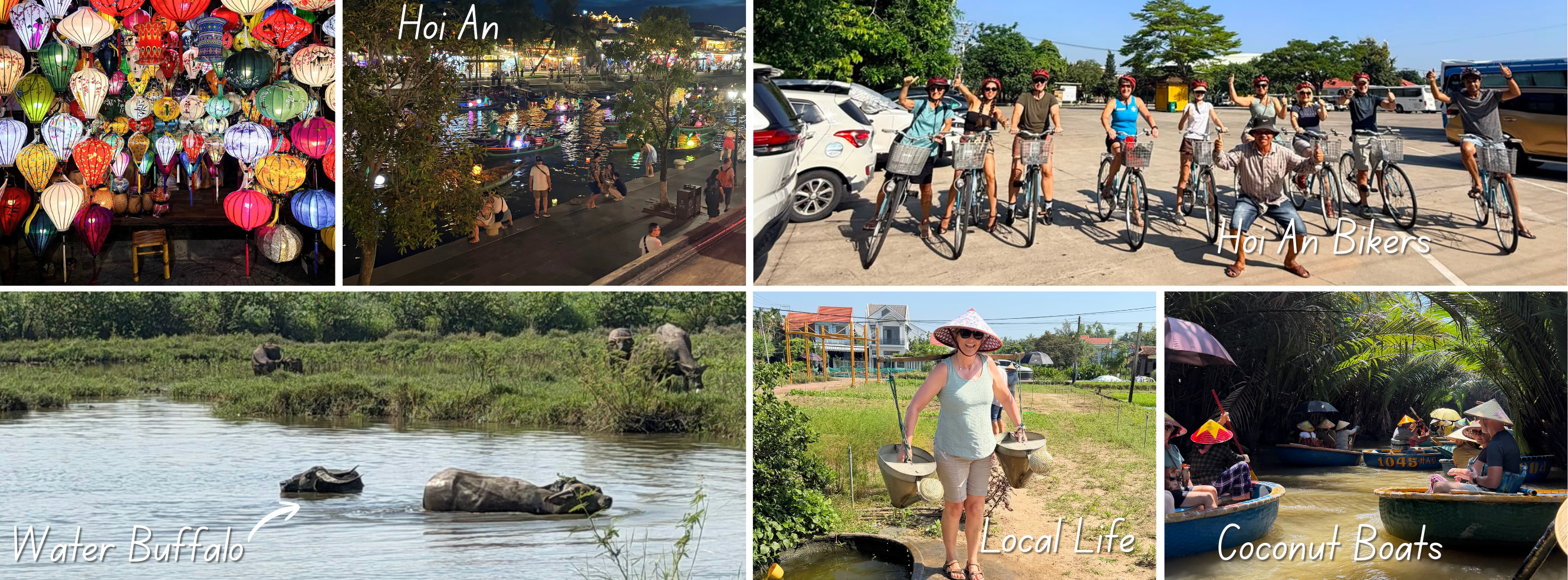
We had lunch at An Bang beach, then checked into our hotel in town and did an orientation walk through the Ancient Town. We visited Yally, one of the well-known tailors for custom-made clothing, and got our first taste of Hoi An’s charming streets.
Dinner with the group followed, overlooking the river as colourful boats and lanterns lit up the water.
Countryside cycling and coconut boats
Next morning we explored the Hoi An countryside by bicycle:
- We cycled through rice fields, passing water buffalo wallowing lazily in the mud.
- At an open vegetable farm we learnt how families grow herbs and vegetables on government land and sell them at the market. We tasted different herbs and tried watering the crops in the traditional way.
- At a local house we sampled both rice wine and banana wine.
- We prepared our own fresh spring rolls as a snack.
- Later, we boarded the famous Hoi An coconut basket boats (thung chai) and glided through water coconut palms. Our oarswoman was a character, singing and laughing with the other boat ladies as they spun the boats in dizzying circles.
I will be honest: the coconut boat area is commercial and touristy, and it was very hot. But it is also one of those “you have to do it once” experiences, and I am glad we did.
To finish, the bikes were loaded onto a boat for a gentle ride back towards the old town, then we cycled the last stretch to the hotel.
Beach time and lantern workshop
Later that day we took a taxi back to An Bang beach, and I swam in the South China Sea, which was the warmest sea I have ever been in. It was simple but joyful, and a lovely break from the busyness.
That evening we were collected for a lantern-making workshop:
- We learnt how to make silk lanterns and delicate paper lanterns that you later set adrift on the river, each carrying a written wish.
- The silk lanterns are fiddly; the glue is strong; my instructor was very strict; and I ended up with glue everywhere. The young locals made it look effortless.
- Despite my lantern looking like it had had a rough week, it glowed beautifully and I loved it.
Afterwards we boarded small boats and floated along the river, releasing our paper lanterns and watching hundreds of glowing lights drift downstream. Hoi An after dark, with the old town bathed in lantern light, is one of the most magical sights in Vietnam.
Day 11: Da Nang, Ba Na Hills and Marble Mountain
From Hoi An we took a day trip around Da Nang.
Lady Buddha and Linh Ung Pagoda
We began at Linh Ung Pagoda on the Son Tra Peninsula, home to the 67-metre-tall Lady Buddha statue of Quan Am, the Goddess of Mercy. Set in landscaped gardens with shrines and coastal views, it feels calm despite its popularity.
Ba Na Hills and Golden Bridge
Next was Ba Na Hills, a hilltop resort originally developed by the French and now a cool escape from the heat below. We rode the long cable car, enjoyed the mountain air and wandered the French-style village and gardens.
The big draw is the Golden Bridge, a 150-metre pedestrian bridge seemingly held in two giant stone hands. It is every bit as striking as the photos suggest, and it is busy, but the views are worth it. We also tried the adventure coaster. The views were great, the adrenaline less so, but it was fun to tick off.
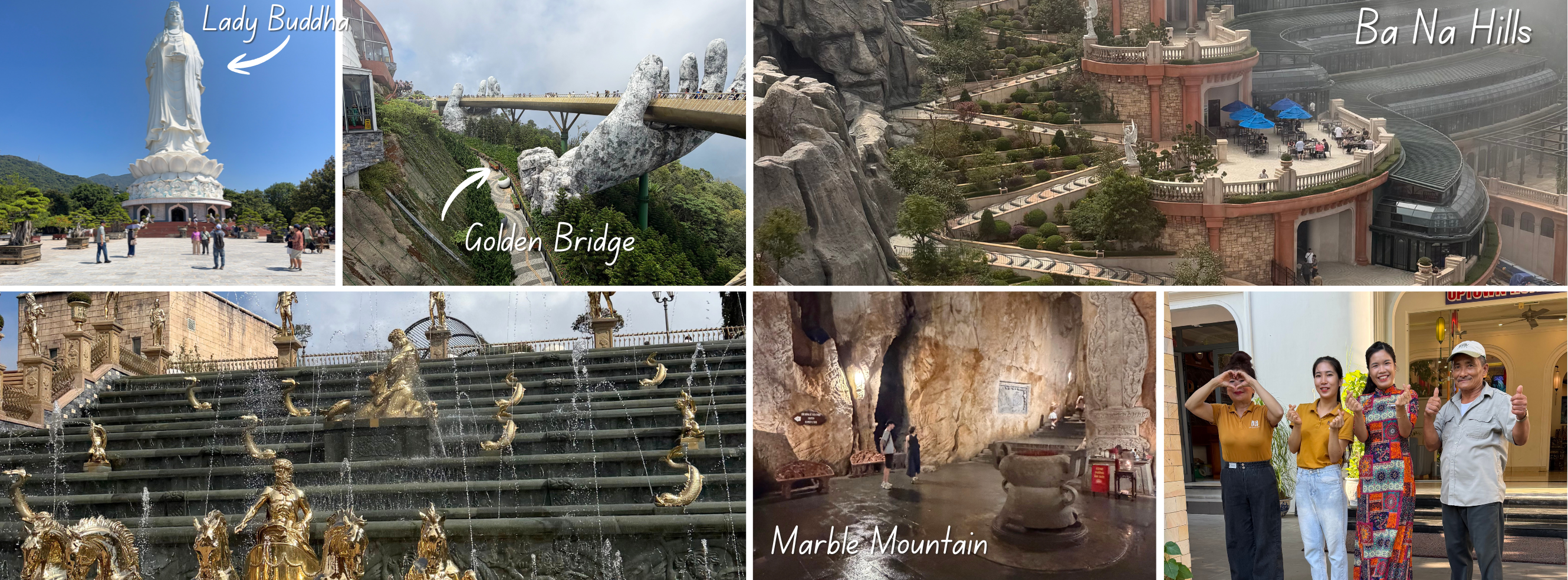
We then wandered into a huge beer hall, soaked up the atmosphere and eventually took the cable car back down, taking in the last of the mountain views.
Marble Mountain
On the way back we stopped at Marble Mountain, a cluster of marble and limestone hills just inland from the sea. We climbed stone steps past carved Buddhas and incense smoke into a large cave where light pours in through a hole in the roof. It was humid, a little slippery, and entirely worth the effort.
At the base, stone-carving workshops line the streets, the sound of chisels echoing through the village.
Back in Hoi An we squeezed in some practical shopping: new trekking sandals and a replacement power bank, then dinner at a riverside restaurant and a last wander through the lit-up streets.
Days 12–14: Ho Chi Minh City and Cu Chi Tunnels
From Da Nang we flew south to Ho Chi Minh City (Saigon), still often called Saigon by locals.
Accommodation on this tour was never luxury, but it was always clean and comfortable, which is exactly what you need when you are out exploring most of the day.
Saigon city sights and war history
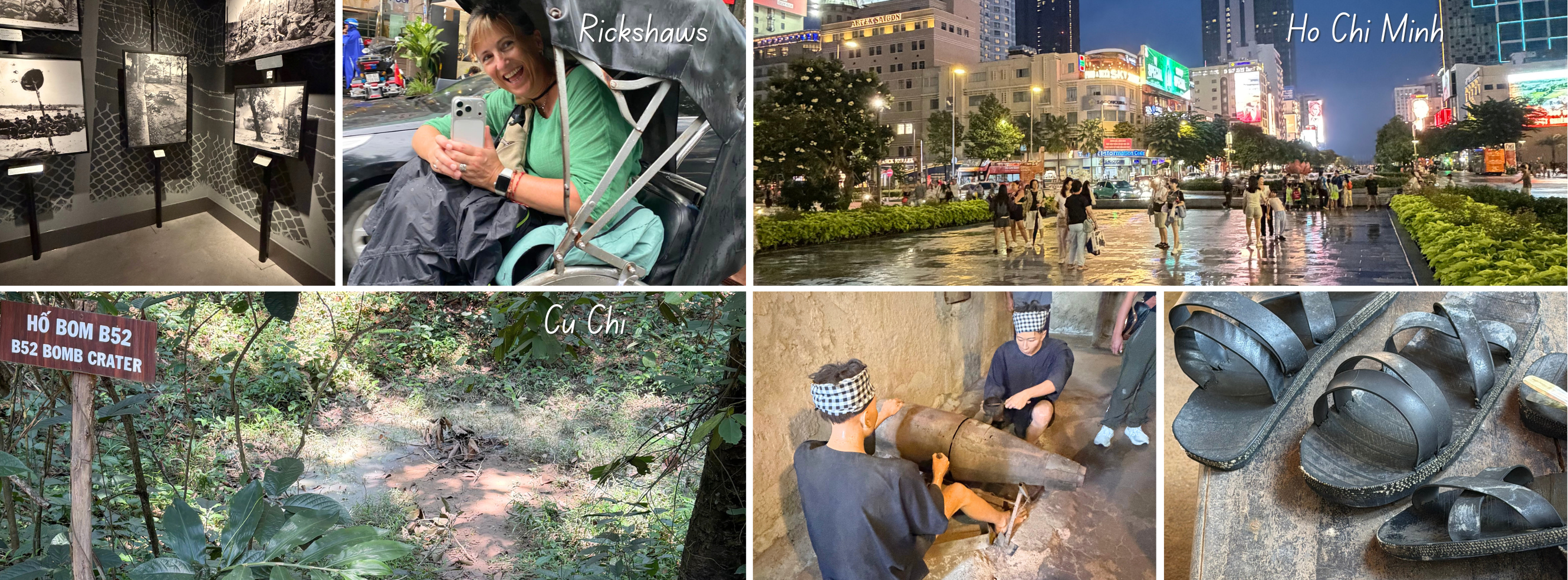
Our time in the city included:
- The War Remnants Museum, where we spent a couple of sombre hours learning about the Vietnam War from a Vietnamese perspective. It is confronting, powerful and leaves a deep impression.
- A cyclo (rickshaw) ride through the city streets, surrounded by thousands of scooters. You have to surrender to the chaos, trust your driver and enjoy the ride.
- A visit to the Thích Quảng Đức memorial, marking the spot where the monk famously self-immolated in 1963 in protest against the government’s treatment of Buddhists.
- Time around the Independence (Reunification) Palace and the building behind one of the iconic helicopter evacuation photographs from 1975.
- Passing by City Hall, the Central Post Office and the Notre Dame–style cathedral, plus a buzzing local food market where we ate fresh, flavour-packed dishes.
We finished one evening with cocktails on the 26th floor of a modern tower, with fabulous views over the city lights, then walked through the nightlife hub of Bui Vien walking street: loud, neon and packed with bars and people. I felt a good thirty years too old for it, but it was a sight worth seeing.
Cu Chi Tunnels
Another day was dedicated to the Cu Chi Tunnels, about an hour and a half from the city:
- This vast underground network once stretched for more than 200 km, with living quarters, kitchens, storage rooms, meeting spaces and field hospitals hidden under the jungle.
- We saw tiny camouflaged tunnel entrances hidden under leaves, the simple but nasty traps used during the war, and learnt how people lived, cooked and fought from underground.
- A section of tunnel has been widened for visitors to crawl through. Even so, it is hot, cramped and claustrophobic. Emerging into the light again is a relief and brings home how incredibly tough life must have been in the original, narrower tunnels.
- Afterwards we tried tapioca and tea, the kind of simple food the Viet Cong survived on for long stretches.
All the while, the crack of gunfire from the onsite shooting range echoed through the trees, adding to the atmosphere.
Final goodbyes and reflections
Back in Ho Chi Minh City we squeezed in some last-minute shopping and even a visit to a spa for facials and a blissful head massage and blow dry. A small luxury after a heavy morning.
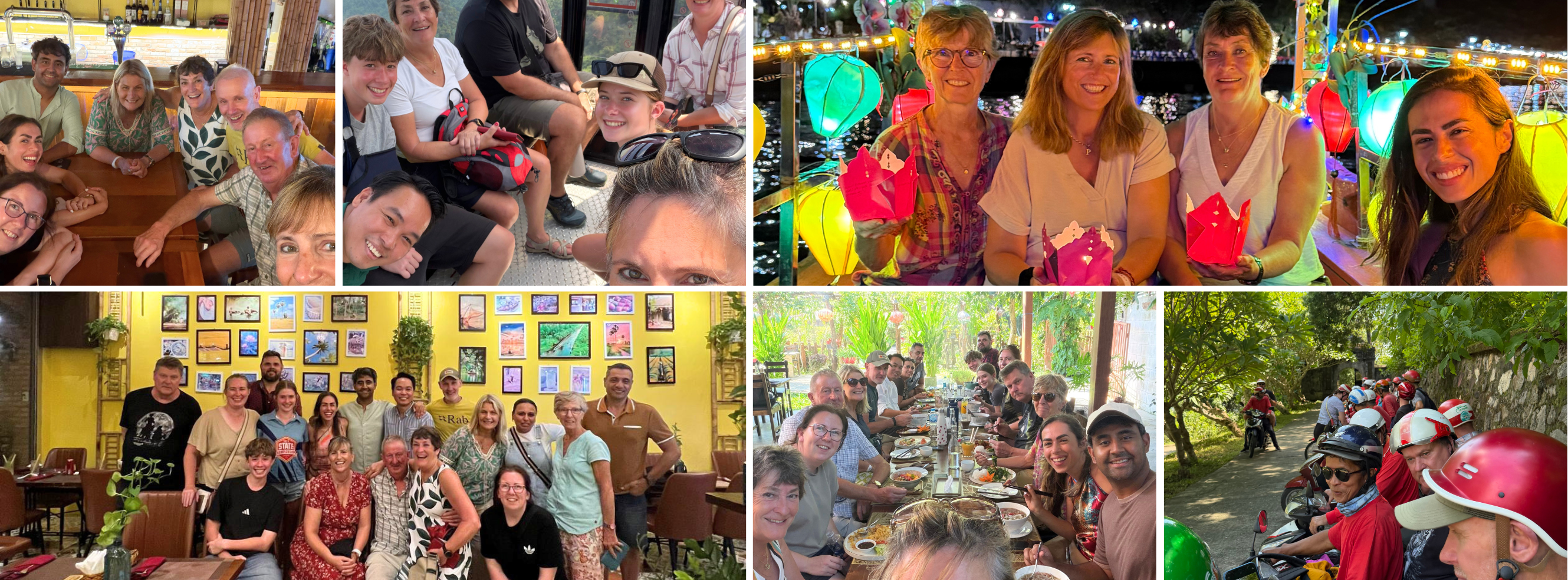
On our final evening we gathered for a farewell dinner. There was laughter, a few tears and lots of “we must keep in touch” promises. Our guide, Son, had been brilliant from start to finish, quietly dealing with his own challenges while looking after us all. The group felt like a little family by the end.
Some people with early flights bowed out, while a few of us made a last foray to Bui Vien for one more drink. Walking back to the hotel that night, it was hard to believe it was almost over. Tomorrow would feel very strange without the group.
Is a Vietnam small group tour right for you?
If you like the idea of:
- Seeing Hanoi, Halong Bay, Hue, Hoi An, Da Nang and Ho Chi Minh City in one trip
- Having logistics and key experiences organised for you
- Travelling with a small group and local guide, with built-in company and support
- Mixing cities, countryside, beaches, history and culture
…then a two-week small group tour from Hanoi to Ho Chi Minh City could be exactly what you are looking for.
I would happily recommend this style of Vietnam trip to my own friends and family. And if you would like to talk through whether it is right for you, I can help you shape the perfect version for your own travel style and pace.
Additional Blogs to support this trip (currently under construction)
- Hanoi City Guide & Train Street
- Halong Bay Cruise Experience
- Sleeper Train and Overland Travel in Vietnam
- Hue by Motorbike
- Hoi An Lanterns, Cycling and Local Life
- Da Nang, Ba Na Hills & Marble Mountain Day Trip
- Ho Chi Minh City & Cu Chi Tunnels
- Is Vietnam Small Group Tour Right For You