Da Nang Day Trip
Lady Buddha, Ba Na Hills & Marble Mountain
If you are staying in Hoi An or Hue, a day trip around Da Nang is a fantastic way to break up temple hopping and lantern spotting with big views, cool mountain air and some seriously dramatic sights. On my Vietnam tour, we spent a full day visiting Linh Ung Pagoda and the Lady Buddha, heading up into the mountains at Ba Na Hills to see the Golden Bridge, and then climbing through caves at Marble Mountain before heading back to Hoi An for supper and shopping. It turned out to be one of those perfectly balanced days that mixed culture, scenery and a touch of theme park fun. Here is what it was really like and how to make the most of a Da Nang, Ba Na Hills and Marble Mountain day trip.
Why include Da Nang in your Vietnam itinerary?
Da Nang often gets overshadowed by its more famous neighbours, Hue and Hoi An, but it makes a brilliant base for a day of:
- Coastal and city views
- A dramatic hilltop resort and the Insta‑famous Golden Bridge
- Atmospheric caves and pagodas at Marble Mountain
From Hoi An, it is an easy drive; from Hue, it is often part of a longer journey between the two cities. Either way, you can comfortably see Da Nang’s big‑ticket sights in one full day.
Stop 1: Linh Ung Pagoda & the Lady Buddha
We started on the Son Tra Peninsula, a headland that juts out into the sea just north‑east of Da Nang. Perched here is Linh Ung Pagoda, home to one of Vietnam’s most striking statues: the Lady Buddha.
Meeting the Lady Buddha
The Lady Buddha is:
- A 67‑metre‑tall white statue of Quan Am, the Goddess of Mercy
- Said to be the tallest of its kind in Vietnam
- Turned towards the sea, traditionally seen as a protector of local fishermen
Even if you have seen photos before, standing at her feet is impressive. The scale only really hits you when you look up from the base and realise how small the people on the terraces look.
The pagoda complex
The Linh Ung Pagoda grounds are more than just a pedestal for the statue. They include:
- Pagodas and shrines with curved, tiled roofs
- Courtyards lined with bonsai and statues
- Manicured gardens with sea views
It feels surprisingly peaceful given how many people visit. Monks move quietly between buildings, incense drifts in the air, and beyond the walls you can see the sea stretching away below.
It is an excellent first stop because it eases you into the day:
- A little light walking
- A lot of “wow” factor
- Clear views back towards Da Nang and along the coast on a fine day
Dress modestly (shoulders and knees covered), and bring water and a hat; there is shade, but the courtyards can still be hot.
Stop 2: Ba Na Hills – cable cars, French village and Golden Bridge
From the coast we continued inland and upwards to Ba Na Hills, a former French hill station reinvented as a resort high in the Truong Son mountain range.
Ba Na Hills sits around 1,400 metres above sea level, and you really feel the difference when you step off the cable car: the air is cooler, the light is different, and the hectic energy of the lowlands drops away.
The cable car journey
Getting there is an experience in itself. The cable cars at Ba Na Hills are among the longest in the world, and the ride gives you:
- Sweeping views of forested mountains and valleys
- A bird’s‑eye look back towards the coast if it is clear
- A few minutes of silence as you glide up and away from the bustle below
Even if you are not a theme‑park person, the cable car alone is worth the trip.
A French village in the clouds
At the top, you step out into something that feels slightly surreal: a French‑style village in the clouds.
You will find:
- Faux‑European streets with stone facades and towers
- Squares, fountains and little corners set up for photos
- Restaurants, cafés and an enormous beer hall
It is unashamedly theatrical, and yes, quite touristy, but there is also something oddly delightful about wandering cobbled “French” lanes in the middle of Vietnam with mist drifting around you.
The Golden Bridge (Cau Vang)
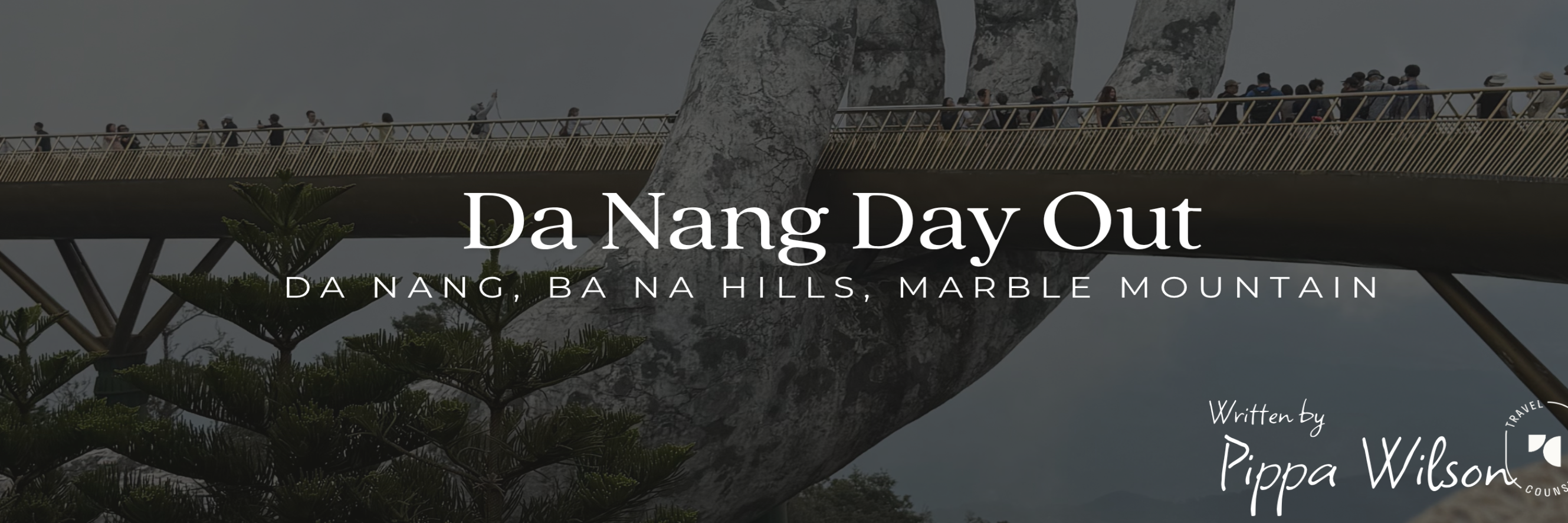
The big star, of course, is the Golden Bridge, or Cau Vang.
The Golden Bridge is:
- A 150‑metre pedestrian bridge that curves around the hillside
- Painted in a gold hue, with balustrades that gleam in the sun
- Most famous for the two giant stone hands that appear to hold it up from below
You have almost certainly seen it on Instagram or in travel magazines. In person, it is every bit as striking as the images suggest.
What it is really like
A few honest notes:
- It is busy, especially in the middle of the day and peak season. You will not have it to yourself.
- There can be queues for the best photo spots, particularly near the hands.
- Weather changes quickly; on some days it is bathed in sun, on others shrouded in mist, which can be moody and beautiful in its own right.
We walked the length of the bridge, stopped for photos, and then doubled back to absorb the details: the texture of the “stone” hands, the views down into the valley between the railings, the way the bridge curves away into the clouds.
It is undeniably built for impact, but that does not make it any less fun to experience.
A touch of theme‑park fun
Ba Na Hills also has:
- Gardens and pagodas to wander
- An amusement park with rides and an adventure coaster
- Indoor attractions and arcades
I took a ride on the adventure coaster with a couple of others. The views were fantastic; the adrenaline, less so. I went flat out and did not touch the brakes once, and it still felt more scenic than scary.
After that, we stumbled into the massive beer hall, which felt like being dropped into Bavaria. It is atmospheric, lively, and a good place to sit for a while and people‑watch.
Eventually, we took the cable car back down, soaking up the last of the mountain views as we descended.
Stop 3: Marble Mountain – caves, pagodas and stone carvers
Back at ground level, our final major stop of the day was Marble Mountain, or rather the main hill in the cluster, Thuy Son.
Climbing Thuy Son
Marble Mountain is actually a group of five marble and limestone hills that rise abruptly from the otherwise flat coastal plain. Each is said to represent one of the elements, and Thuy Son, the “Water” mountain, is the most developed for visitors.
To explore, you:
- Climb stone steps up the hillside (it is a workout, but there are rest points)
- Pass small shrines and pagodas tucked into ledges and clearings
- Catch glimpses of the sea and Da Nang below through breaks in the trees
It is humid, and some steps are a little worn, so good footwear is essential. But the effort is repeatedly rewarded.
Caves and light
The highlight for me was the large cave we entered near the top. Inside:
- The temperature drops, but the air is thick and moist
- Shafts of light pour in through a hole in the roof, cutting through incense smoke
- Statuary and small shrines are carved directly into the rock
It has a slightly otherworldly, almost cinematic feel: cool stone, the echo of footsteps, incense curling upwards into the beam of light. It is one of those places that feels far more dramatic in reality than any photo can quite capture.
We lingered there for a while, emerging back into the humidity feeling like we had stepped between worlds.
Stone carvers’ village
At the base of the mountain, the village is full of stone‑carving workshops and showrooms. The sound of chiselling is constant: a background soundtrack of metal on stone.
You will see:
- Statues in various stages of completion
- Ornate Buddhas, lions, and decorative pieces
- Smaller works you can actually imagine fitting in a garden or on a shelf
Even if you are not in the market for anything, it is fascinating to watch the craft in action.
Back to Hoi An: practical shopping and a well‑earned supper
After Marble Mountain, we drove back to Hoi An, tired in that very satisfying way that only a full sightseeing day can deliver.
Back in town, I ended up doing probably the most practical shopping of the whole trip:
- A new pair of trekking sandals (I live in these when I travel)
- A power bank, since mine had finally given up
Then it was on to supper at Lantern House in the old town, followed by a drink by the river, watching yet more lanterns drift across the water. By the time we walked back to the hotel, Da Nang’s mountains and caves felt a world away, even though they were only a short drive up the coast.
Tips for planning a Da Nang, Ba Na Hills and Marble Mountain day
If you are considering this day trip for yourself or your clients, here are a few practical pointers:
How long do you need?
- Allow a full day. With hotel pick‑up, drives between sights, cable cars, and time to explore each stop properly, you will use it.
- Start early to avoid the worst of the heat at Linh Ung and have time at Ba Na Hills before it gets too crowded.
What to wear and bring
- Comfortable, breathable clothing
- Shoulders and knees covered for pagodas and temples
- Good walking shoes or sandals with decent grip for Marble Mountain
- A light jacket or extra layer for Ba Na Hills; it can be cooler at altitude
- Water, suncream and a hat
Who will enjoy this trip?
This day trip is ideal for:
- Travellers who like big views and iconic photo spots (Golden Bridge, Lady Buddha)
- People who enjoy a little walking and climbing, but do not mind steps
- Families, as Ba Na Hills has plenty to keep children entertained
- Anyone who appreciates seeing the contrast between coast, mountains and caves in one day
It may be less suitable for:
- Those with serious mobility issues, due to steps at Marble Mountain and some walking at Ba Na Hills
- Travellers who dislike heights, as cable cars and the Golden Bridge are unavoidable stars of the show
Why this Da Nang day stays with you
What I loved most about this day was the variety:
- A serene, sea‑facing statue protecting fishermen
- A playful mountaintop “village” in the clouds, with one of the world’s most recognisable bridges
- Ancient caves and pagodas carved into marble and limestone, with incense swirling in beams of light
It felt like three different atmospheres rolled into one trip, tied together by the drive along the central coast.
If you are already planning to visit Hoi An or Hue, weaving in a Da Nang, Ba Na Hills and Marble Mountain day trip is, in my view, absolutely worth it. It adds height, drama and a touch of fantasy to a journey that might otherwise be all about rivers and old towns.
And if you would like help slotting this into a wider Vietnam itinerary – balancing city days, countryside cycling, Halong Bay, Hue and Hoi An – I can help you design something that flows beautifully and makes the most of every stop.
My Two Week Vietnam Itinerary can be seen here - Two Weeks in Vietnam